History
-
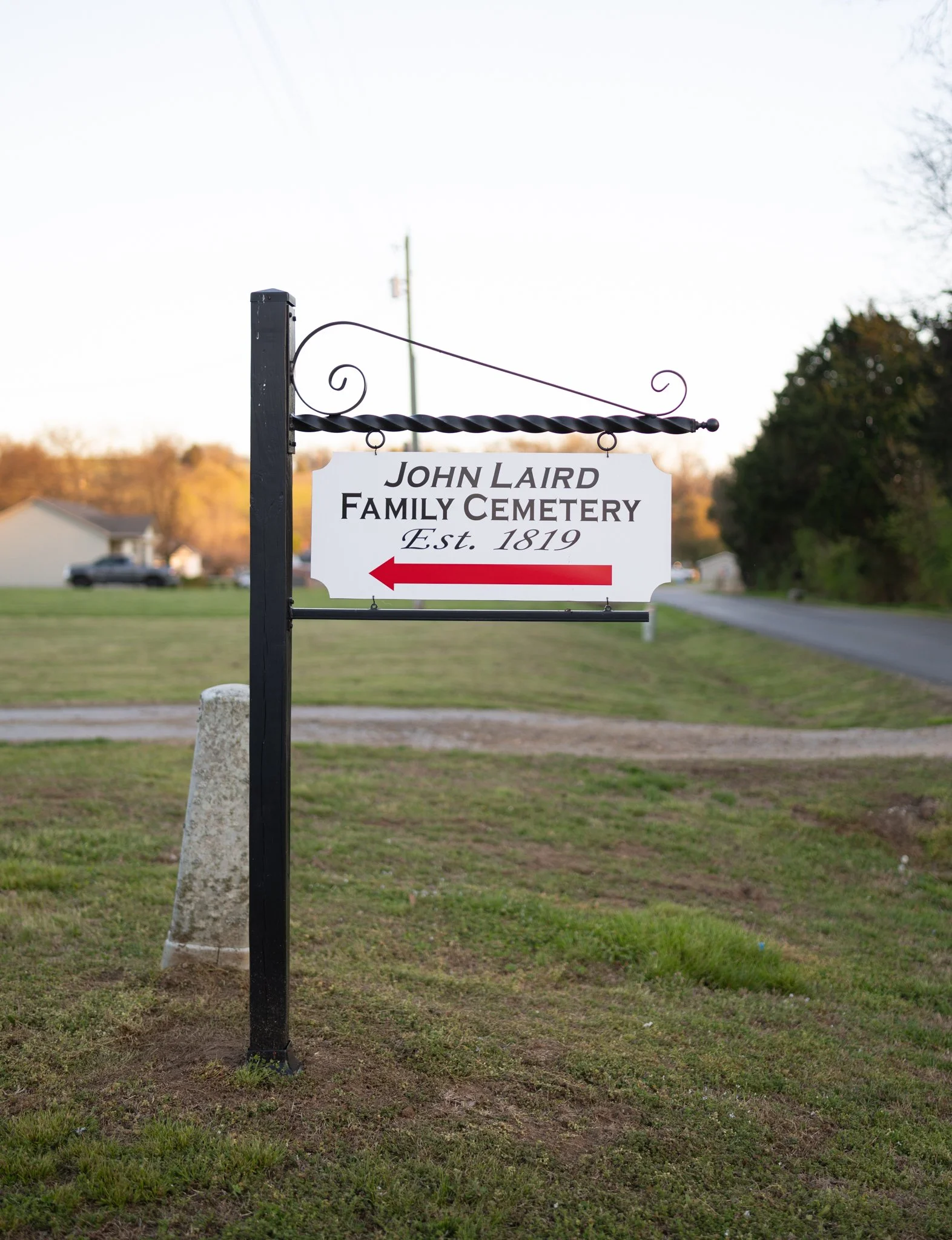
The cemetery was originally known as the Laird family burial ground. In 2004, when the group of local descendants organized to restore and preserve the cemetery, they decided to rename it the John Laird Cemetery.
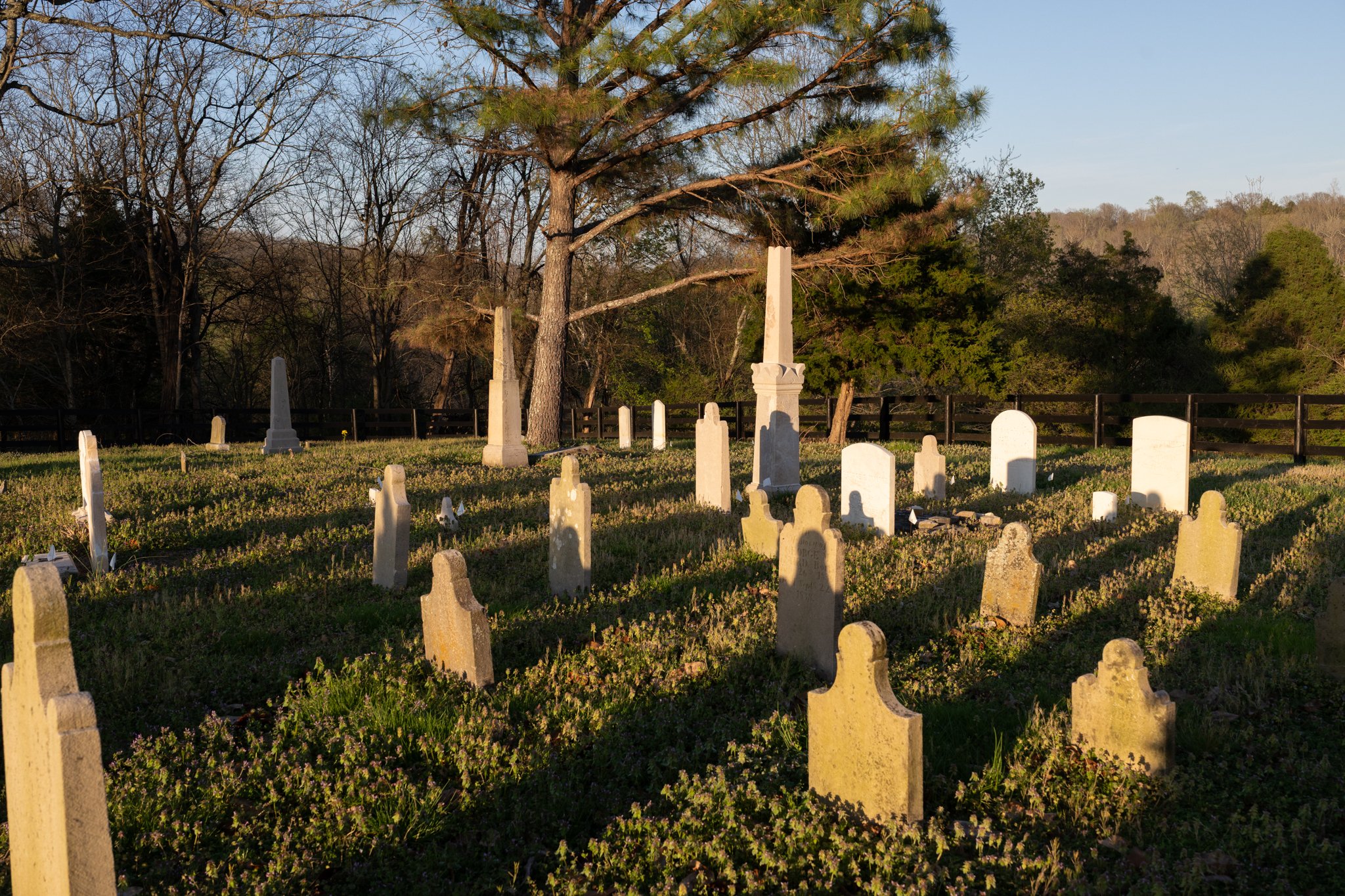
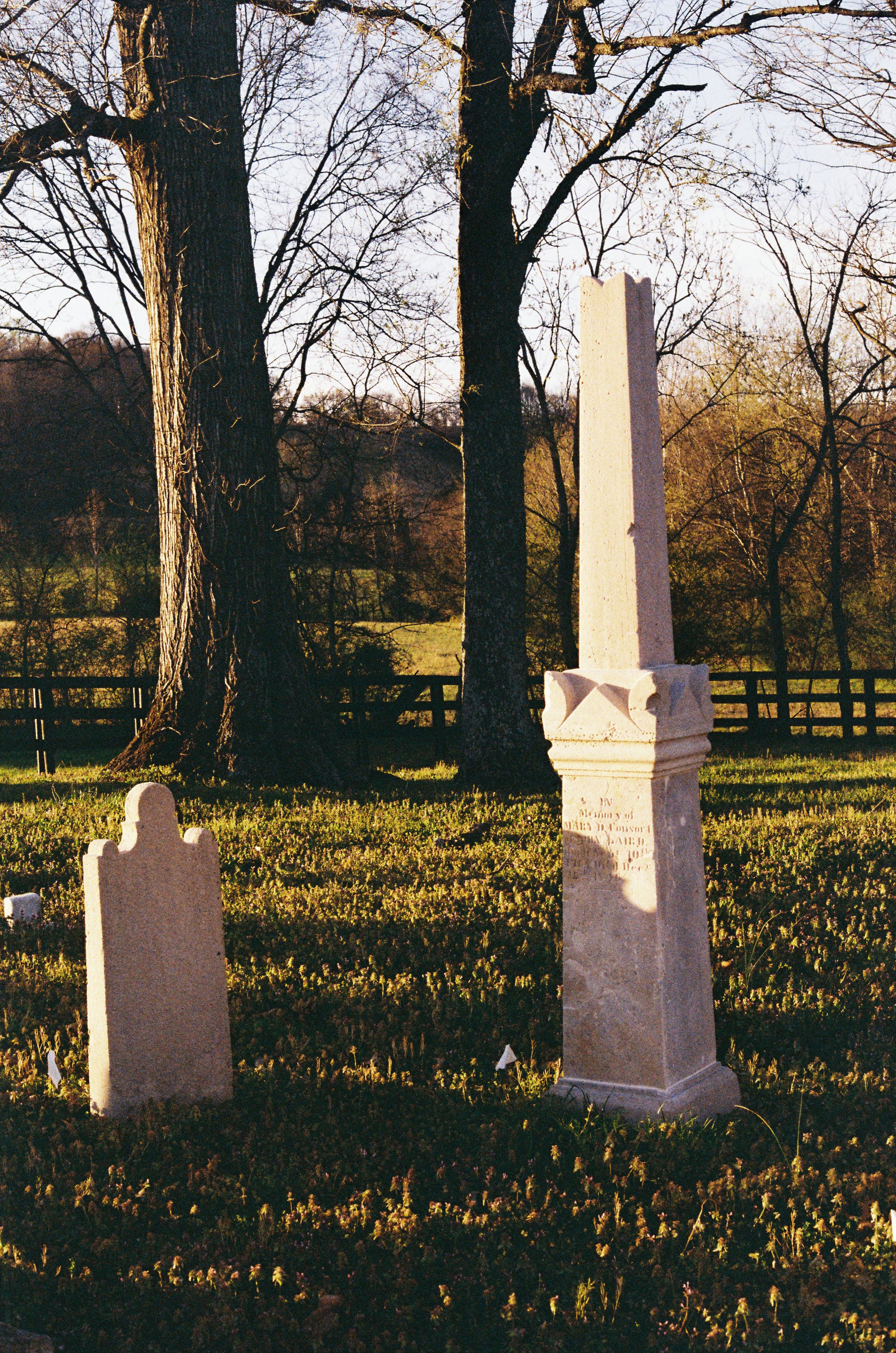
John and Mary’s Laird’s son, John, died at age twenty-two and was the first person buried in the John Laird Cemetery. Most of the Laird family graves are marked by formally inscribed grave markers, primarily obelisks or vertical head and foot limestone tablets. Other graves are simply marked on the surface by roughly dressed, uninscribed slabs of limestone set vertically at the head and foot of each grave and have lost their identity. Some are marked by small stones with no inscriptions and may be the graves of unknown individuals, including infants or enslaved people.
After John Laird's death, various descendants owned the land around the cemetery until it was sold to Thomas Clay Aymett following the death of Lillie Witt Reid, a great-granddaughter of John Laird. Mr. Aymett, in turn, sold it to Clarence Alexander, who decided in the spring of 2004 to divide and auction the land. This decision prompted a group of descendants to form the John Laird Cemetery Association to conserve and preserve the cemetery.
The Cemetery Records of Giles County list seventy-one individuals buried in the cemetery. However, archaeological work done in the cemetery in 2026 found that up to 194 potential unmarked burials in the cemetery, therefore extending those buried here far beyond the bounds of the Laird family alone.
-
John Laird was born March 17, 1770, in Leck Parish in the county of Donnegall in the province of Ulster in Ireland and died December 27, 1861, in Old Lynnville (now Waco) in Giles County, Tennessee. He was one of ten children born to John Laird, Sr. and Elizabeth Armstrong.
John Laird was encouraged to immigrate to America by his maternal uncles, John and Martin Armstrong, who had settled near a Moravian settlement in Stokes County, North Carolina. Both uncles had fought in the Revolutionary War and were paid by North Carolina in land warrants for Tennessee. They became quite prosperous by buying thousands of acres in Middle Tennessee that they, in turn, sold to the settlers. Because of their many land dealings, Martin became known as the "Old Surveyor" and John as the "Old Entry Taker."
In 1789 John Laird set sail for America and, after a voyage of three months, arrived in Pennsylvania. He then traveled by foot to Germanton, Stokes County, North Carolina, where his uncles had settled. There, he taught school for four years, and in 1792, married Anna Maria Frey Tuttle, a widow with two small children.
Anna Maria was born September 10, 1768, in Stokes County, North Carolina, and died December 16, 1846, in Old Lynnville, Giles County, Tennessee. John and Mary, as she came to be called, had seven children while living in North Carolina and two in Tennessee.
On June 24, 1809, John Laird received his Certificate of Naturalization at the Court House in Germanton, North Carolina. Shortly afterward, John and Mary left North Carolina for Middle Tennessee with their combined nine children. They were among the earliest settlers in Northern Giles County. It is believed they crossed the Duck River at Davis' Ford, crossed the ridge at Dodson Gap, came to old Mrs. Follis's, then to Lynnville and hence to Old Lynnville. For the first year or so, they lived in a house on the Martin Fry farm until John Laird acquired his land.
Early deeds recorded in Giles County show that John Laird purchased a 328-acre tract on Lynn Creek in 1811. Between then and 1828, he came to own 762.5 acres in Old Lynnville. Laird opened Lynnville’s first general store, became the postmaster, and operated a cotton gin. Much of the weaving took place in a room attached to the back of his house, termed the “loom room”.
John Laird first built a house made of logs hewn from trees cut on his land, located one-half mile north of Old Lynnville on the Nashville and Decatur turnpike, now known as Highway 31. Around 1814, he built a brick house with bricks hand-made on the property and converted the log house into a barn. Two of John Laird's daughters, Patsy and Ann, recalled in later years helping to build the house. Young girls at the time, Patsy could carry two bricks in her apron and Ann only one at a time in hers.
John Laird outlived Mary Laird by fifteen years. After her death in 1846, Robert Henderson Laird and his family moved into the home and lived with John until his death. While they lived there, Robert Laird had a governess for his daughter, and the loom room was converted into a classroom. Some of his nieces, close relatives, and friend’s daughters took advantage of this opportunity to get an education.
John Laird died in 1861. Among his effects was a linen sheet that had been made from flax grown on the farm. The flax was gathered and spun into linen on a little flax wheel they used for this purpose. His daughter Nancy cut the sheet into squares so that each granddaughter might have a piece to embroider as a souvenir of their former home industry.
Known Individuals Buried in the john laird cemetery